Charles William Gillings
Born 24 April 1890 -
Died in the Battle of the Somme 18 July 1916
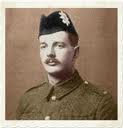 My
Great Uncle, Charles William Gillings, was the son of William and Phyllis
Marguerite Gillings, of Great Barton, Bury St. Edmunds, Suffolk. He was
born on 24th April 1890 at Orford in Suffolk.
My
Great Uncle, Charles William Gillings, was the son of William and Phyllis
Marguerite Gillings, of Great Barton, Bury St. Edmunds, Suffolk. He was
born on 24th April 1890 at Orford in Suffolk.
Early life
His first attempt to join
the police service was unsuccessful when the Metropolitan Police rejected his
application as he was too young. He then found employment as a game keeper
at the Burghley House estate in Lincolnshire, belonging to the Marquis of
Exeter.
On 16th February 1912 at the age of 21 he finally joined the police, serving
with the Grantham Borough Police. On 6th February 1914 an advertisement
appeared in the Police Review seeking candidates for the Southend-on-Sea County
Borough Constabulary which was to take over policing the town from 1st April
1914. Charles, seeing an opportunity for advancement applied and by 20th
February 1914 he was in Southend attending his interview and medical. His
application form described him thus - aged 23, height 6ft 1 in, weight 13 stones
7lbs, chest measurement 38 inches, hazel eyes, brown hair, fresh complexion,
gamekeeper by trade, single and resident at 40 Green Hill Road in Grantham',
while his parents were living at Wylde Street in Mildenhall, Suffolk.
Among those recommending his appointment were the Mayor and Vicar of Grantham.
His application was fully supported by the Chief Constable of Grantham, J R
Casburn who wrote to his counterpart at Southend, Henry Kerslake, stating;
"Gillings has been here just over two years and is a most painstaking
officer. He is very steady, reliable and always attentive. I am certain that he
will prove a most capable officer. He is well liked by his fellows and the
general public. I think very well of him and shall be very sorry to lose him,
but as there is not much chance of promotion here, this being a small force, I
feel I should be doing wrong by standing in the way of his gaining promotion
elsewhere. I can thoroughly recommend him"
Not surprisingly Charles was accepted by the Southend-on-Sea County Borough
Constabulary. His record of service shows his date of joining as 30th
March 1914, the day before the force was officially established. He was
one of 23 transferees or new recruits who joined 78 men from the Essex County
Constabulary to form the new Southend force. Within months Britain was at
war and on 17th October 1914 Charles wrote to the Chief Constable seeking
permission to join the army for the duration of the war,
"provided that I should be allowed to rejoin this force and would the service
I now have to my credit count for pension purposes".
Three days later Charles wrote again to the Chief Constable reporting;
"I have been accepted for His Majesty's Army. I shall be glad if you will
allow me to resign from this force on Wednesday October 21st. I leave
early on Thursday morning to join my regiment."
Two days later the Chief Clerk reported that Charles "handed in his uniform
and accoutrements on this date and was paid off".
World War 1
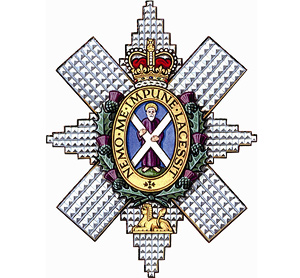
Charles enlisted to join the army in Southend as Private S/6258 with the 8th
Battalion, Black Watch (Royal Highlanders). He was twice wounded - first
at Festubert and second at Loos during the battles of 1915.
In summer of 1916, Charles was engaged in the bloody attempt to capture Longueval at Delville Wood. A full description of that can be found here.
He was killed by a single
shell at Longueval on 18 July 1916 which killed five of a group of seven -
Gilliings was binding up a wounded comrade at the time. He was aged 26 and
described by his commanding officer as "one of his best officers".
Aftermath
Southend's Chief Constable was told the news in a letter from Charles' father,
William, dated 13th August 1916.
He wrote,
'It is with much regret that I beg to inform you that I received a letter
from the Colonel of the 8th Battalion, Black Watch (Royal Highlanders) on the
9th instant telling me that my son, Corporal Gillings of that battalion was
killed in action at Lonqueval on the 18th July last. Allow me to say I had
very much looked forward to his rejoining the Southend force under your
command."
This was a start of a sad exchange of letters between Chief Constable Kerslake
and the family. On 4th October 1916 Charles' brother, Driver H Gillings,
wrote to the Chief Constable;
"Please allow me to express to you on behalf of his remaining brothers and
sisters - including myself - our grateful thanks and deep appreciation for your
most kind and sympathetic letters to our parents in their bereavement, which I
assure you is a source of great pleasure and deeply appreciated by all of us.
I feel that the least I can do, on behalf of us all, is to let you know that of
all the letters received by our parents, the ones which you so kindly sent are
the most treasured. My father particularly treasures them very very highly
indeed and is so proud of them that he always carries them about with him.
It his greatest pleasure is to show them to anyone who may make a reference to
the death of our dear brother. I am myself proceeding to the front at any
minute."
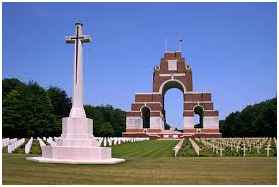 Charles
was buried 150 yards south of Longueval church but his grave must later have
been lost as his name is on the Thiepval Memorial. He is commemorated on
pier and face 10 A of the Thiepval Memorial in Somme, France - one of 73,367 men
listed on the memorial who have no known grave.
Charles
was buried 150 yards south of Longueval church but his grave must later have
been lost as his name is on the Thiepval Memorial. He is commemorated on
pier and face 10 A of the Thiepval Memorial in Somme, France - one of 73,367 men
listed on the memorial who have no known grave.
In Memorial
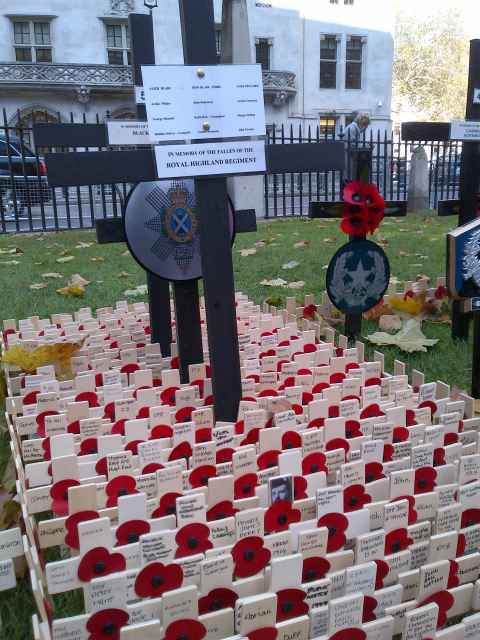
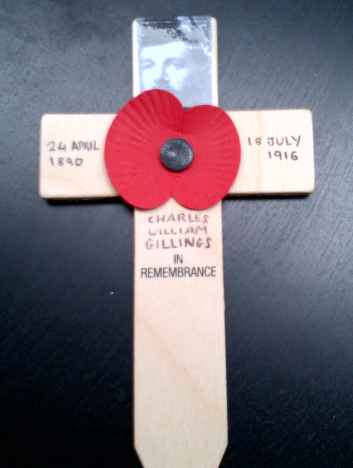
On Thursday 8th November 2012 we planted a cross in the National Field of Remembrance at Westminster Abbey. A very brave man, with no known grave, who is not forgotten.
 |
 |
November 11th 2012 - Article updated with additional information compiled by Mr. Adrian Jones. Additional information taken mainly from the Essex County Chronicle and Essex Weekly News.
Back to garnhams.co.uk